
The Parallel Mind
A Futurist Project for the Reclamation of Earth and Humanity


The world, the universe, is a problem to be solved by love, not by power.
~Pierre Teilhard de Chardin
TLDR
Humanity has a singular mandate: solve the polycrisis, retool all governance mechanisms, or experience a significant die-off event.
The future does not care whether communism or capitalism wins, whether left or right prevails. It does not matter if one “us” gains victory over one “them.” What matters is achieving human coordination toward solving the last problem we’ll ever need to solve. That problem is self-extinction. How do we solve it? We must architect a device or construct that will deliver humankind to a state of wisdom, prosperity, and salvation.
The Parallel Mind is my attempt to approach this problem with humility and grace. It is a lecture series, a book project, and a call to action. I aim to offer a path to healing our wounded planet and saving ourselves, and you are invited to be a part of it. I realize this is a tall order, and I will not pretend to be a guru with all the answers or knowledge. This effort reflects my understanding of our predicament and my unique approach to the available solutions. Ultimately, we need all the intellectual and spiritual capital we can muster.
I hope you will join our community.

Background
I have been mulling over an idea for ongoing educational video content for some time, particularly as it pertains to our most daunting challenges as a species. I have also wanted to share my accumulated knowledge and life’s work, and my favorite medium to deliver this has always been public speaking and dialectical exchange.
The project is now live. It is called "Past & Future: The Parallel Mind.”
I started it as a series of live X Spaces hosted via my account every Friday at 1pm Central Standard Time. You are cordially invited to join the Spaces and contribute to the project (we also have a corresponding Telegram group). I intend to turn the content into a book I will publish via Substack over time. It is one of the few ways to keep myself accountable to a regular writing practice. In line with cypherpunk values, I will open-source the book upon completion and allow others to contribute.
I debated creating a separate Substack for this project because, ostensibly, the material transcends the realm of “counter governance.” However, this publication’s overarching goal — producing institutions and technologies that “counter” legacy paradigms — remains a chief concern of The Parallel Mind. The project only moves beyond counter-governance in that we are embedded in a polycrisis that needs to be addressed and remedied. The causes of polycrisis are deeper and more nuanced than governance malfunctions and institutional failures can account for alone. Let us first define the term, because we will return to it repeatedly.
The polycrisis refers to the simultaneous occurrence of multiple crisis events that beset us and enfold every aspect of human culture, society, and technology. However, the polycrisis is not just a list of potentially catastrophic event scenarios. The interactions between and dynamics within those events also lead to emergent risk vectors that are nearly impossible to detect or predict. Let us consider polycrisis as a crisis field that produces Black Swan eventualities, which emerge from all the interactions, and potentially distribute harms across our planet, its biomes, animals, and people. This cascading set of crises encompasses climate change, political instability, species extinction, the emergence of artificial superintelligence, the creation of synthetic organisms, information asymmetries, and the increasing globalization and hyper-interconnectivity of the world. Chris Hobson elaborated eloquently on the nature of the Polycrisis in his blog:
“Polycrisis captures the awkward and tangled mix of changes, challenges, connections and confrontations, all interacting with one another: bending, blurring and amplifying each other. This is all exacerbated by the way the breakdown of meaning is part of what is occurring.”
We will delve further into the polycrisis throughout this lecture series and in the book chapters.
The following sections contain the summary and thesis (all subject to being updated and changed regularly). It also includes a tentative outline of various ideas, thinkers, and philosophies I will explore through the lectures and supplemental writing. All the sections will be updated as I expand the knowledge base and conduct ongoing research.
Summary: Architecting God?
We are amidst what has been called the End of Times, the Great Turning, the Archaic Revival, the Singularity, the Rapture, or the Omega Point. All these ideas have either a technological or eschatological underpinning, representing the end of the world or the coming of catastrophic alterations to the planet's makeup and the human race. These events are either deeply spiritual, driven by divine intervention, or secular, driven by technological arms races. Perhaps both, as Pierre Teilhard de Chardin articulated in “The Phenomenon of Man.” Chardin claimed the evolutionary process of the universe, the planet, and man is a teleological unfolding that culminates in a convergence with God. Terence McKenna likewise referred to this as the Strange Attractor or final concrescence at the end of history.
Regardless of what descriptor we use or language we champion, our current transitory state is happening and represents a birthing crisis. As a species, we are entering a period of collective growth, maturation, and sensemaking — either that or we are on the eve of permanent self-destruction. This process has been ongoing for millennia and casts a long shadow onto the arc of history, manifesting more acutely in the warp and woof of the current planetary crisis. This existential eruption is only intensified and further understood in the context of the collective meaning crisis we are undergoing. Rates of social anomie, depression, anxiety, other mental health conditions, and rampant suicidality are on the rise.
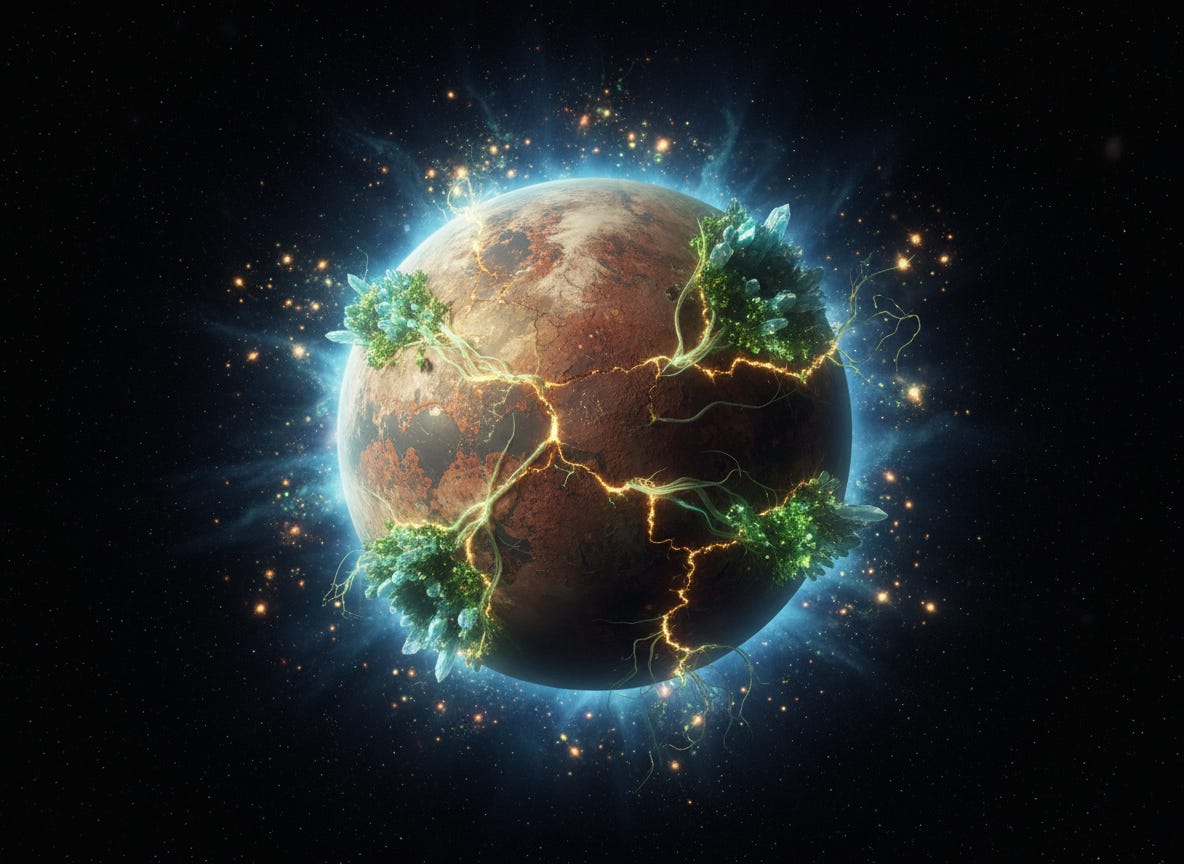
There is no guarantee we will survive or overcome these emergent crises. We could be brought stillborn onto the operating table. We could go extinct, ending our perceived supremacy over Earth. On the other hand, we may get to architect God, a wisdom machine made in our image but with survival protocols built into it. Stewart Brand, creator of the Whole Earth Catalogue in the 1960s, once said, “We are as gods and might as well get good at it.” This “constructing God” sentiment has been a central theme among many spiritual thinkers, unorthodox technologists, and scientists, such as Rupert Sheldrake, Ray Kurzweil, and Fritjof Capra, among others. These unsung heroes of “mystical science” are often considered apostates from legacy institutions and thought by some to be “pseudoscientists.” However, as we process our situation and examine the wounded planet, there may be convincing reasons they are correct as we enter another scientific paradigm shift. We will repeatedly return to this idea of architecting God or constructing some salvation/wisdom device throughout the Parallel Mind series.
This is where we have landed — we are on the launchpad to eternity
Now we must tease apart the insights about what is happening and how to navigate the perilous future. In my estimation, it is all about obtaining wisdom, freedom, and human dignity, discarding blind progress, and embracing a path toward planetary healing. The parallel society and institution movement will play a key role in this collective awakening. That is my overwhelming belief; I hope you can see it, and if not, we will at least have productive debates.
One thing to note is that as we move forward together, I will do my best to dispel all the black pills and nihilism memes that currently infect modern communication channels and discourse. Our analysis will be aggressively solutions-focused, guardedly optimistic, and non-reductionistic. I firmly believe that we must tackle all our crises by thinking about them holistically and ecologically. We will be fervently anti-doomer but will certainly address various concerns and fears.
Next, I will attempt to answer the question: Are we really building God? What are we constructing at the “end of history”?
Parallel Mind Thesis
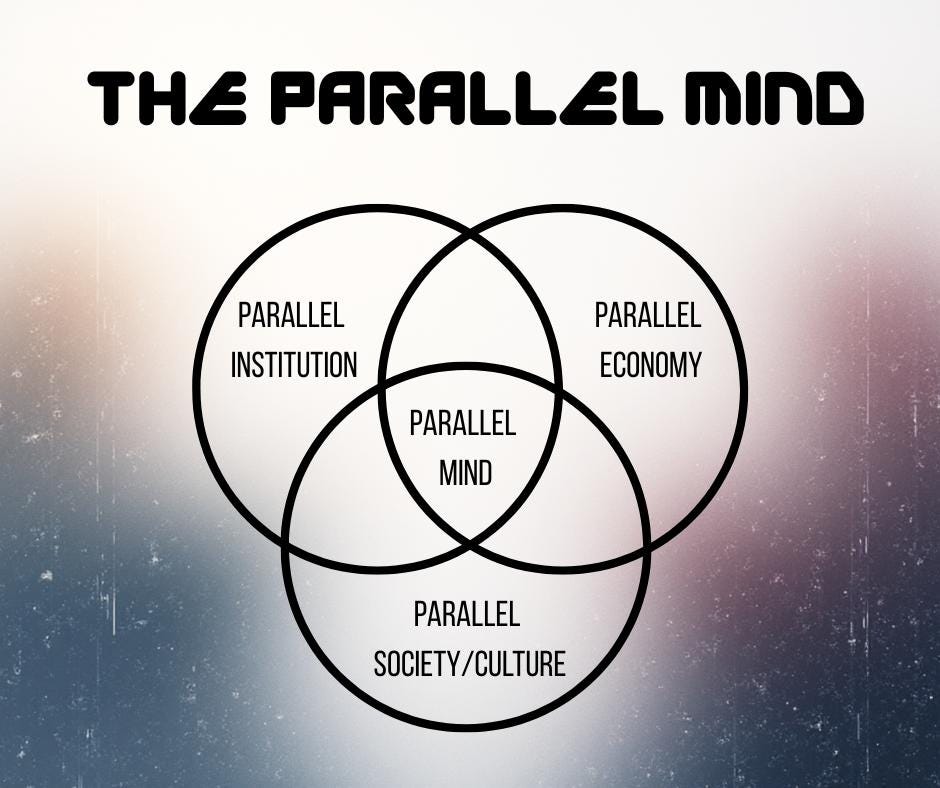
We are constructing, or rather, we must create a parallel mind. Imagine this idea of a parallel mind as the center of a Venn diagram, which contains other technological and social innovations that overlap and interpenetrate. These include parallel financial technologies, institutions, governance schemes, cultures, and societies.
Together, this parallel mind will exist alongside planetary consciousness and our legacy modes of thought. The construction phase initially began with the advancement of communication technologies, including hieroglyphics, clay tablets, papyrus, movable type, the Gutenberg press, computation, networks, decentralized computing, and ultimately, decentralized governance modalities.
When taken together, these tools represent an evolving architecture for salvation. At the same time, they provide us with collective wisdom for natural sustainability, social development, conflict resolution, and the engineering of peace. The parallel mind is necessary to facilitate the parallel processing of social, environmental, cultural, philosophical, and political crises.
The chief insight here is that parallel processing is a force multiplier for solving problems that have become “hyperobjects,” according to Timothy Morton. In other words, they require targeted analysis, sustained innovation, and tremendous focus to solve, because their existence moves beyond human temporal understanding; hyperobjects extend beyond human life spans and impact the environment and information ecologies over the course of centuries. They also encompass numerous realms of analysis, necessitating the implementation of new forms of in-depth analysis to capture their essence, impact, and consequences fully.
I used the metaphor of a parallel mind in conjunction with parallel processing. A key insight from parallelized network architecture is that subsystems and subroutines focus on specified tasks and solve them with greater efficiency. In this regard, parallel processing offers overall scaling and efficiency gains. Think of the human brain. The human brain was once thought to be mechanical and have a more regimented, centralized architecture, with each brain location focusing on a specific function. That was true to an extent. The reality is that the human brain is an efficient, decentralized machine. All parts of the brain are interconnected and “talk to each other” via vast neuronal networks, sort of like multi-computational parallelized processing threads. The brain is the most complicated “machine” in the known universe. Yet, it only uses approximately 20 watts of power, similar to a computer monitor in sleep mode. I will speak more extensively on this topic at a later date, but suffice it to say that we need to create a planetary “noosphereic” version of the human brain, leveraging our computational, social, cultural, economic, and institutional knowledge.
Below is the content flow for the book and the X spaces. I have a more storytelling style, where I weave science, solutions, problems, anecdotes, facts, and narratives together. In this sense, I would not say I am the best at formally structuring content, so there will be a bit of meandering; however, I hope that by the end of these sessions, a coherent structure will emerge. Think of what we are doing as an intellectual manifestation, engaging in fertile discussion that gives rise to innovation in thought and action toward constructing the Parallel Mind.
Content
The following content comprises a diverse array of ideas and thinkers relevant to our discussion. Over time, the content here will evolve, become more organized, and take on a more formal tone. Its current form is a rough outline as I gather my thoughts.
Intro: Ideology fatigue & the Metamodern Turn
Transitionals / gravitationals
Wounded Planet Thesis
A feedback loop between our trauma and destructiveness
Nihilism Economy
Metamodernism
Holism: we are part of the planet
Chardin (Noosphere, threshold of reflection, psychic temperature)
Polycrisis, Meaning Crisis, Governance Crisis
Polycrisis meaning (Daniel Schamtenberger)
Vervaeke (Awakening from the Meaning Crisis)
Psychiatric Industrial Complex (Thomas Szasz, R.D. Laing, etc)
Gregory Bateson, Anthropological Cybernetics, Marin Buber, I-Thou, dialogic and communication philosophy
Emergence and Attractors (Notes on Complexity Science)
Dissipative structures, Nonequilibrium Thermodynamics, Prigogine
The Futurst and the Attractor
Revisiting Chardin’s Noosphere, Lovelock’s Gaia Hypothesis
Timothy Morton, Hyperobjects, data proliferation
Parallel Processing Metaphor / Parallel Philosophy / Salvation Device
Parallel Processing. Focusing on subroutines, subsystems, and specified planetary tasks (The parallel mind). Solving individual problems, locally, globally, universally
Parallel computation
Parallelism in abstractions and ideas
Nonlinear problem solving, nonlinear analytics, quantum analytics
Birth of the Parallel Subject and Object
Invention of Collective MetaCog (planetary metacognition)
Comparisons to psychedelic thought, emotional processing, etc
Discuss countercultural trends
psychopharmacology
Computational drugs
Addressing Luddism, antitechnology activists:
Paul Kingsnorth, anarcho-primitivists, Kirkpatrick Sale, etc
Components of and Framework for the Parallel Mind
Need for Parallel Thought (psychology of the default mode network, linear processing, etc)
Currency/tech (bitcoin, quantum computing, AI, and beyond)
Culture (web3 culture, cultural formation, network culture)
Governance (Will discuss my project, Polis Labs, at length. Will also discuss Logos.co and their solutions at length)
Institutions ( Culture + tech = institution)
Society (institutions + thought)
Parallel Value Sets (PVS) (These value sets are antithetical to “politics” or any flavor of “us-versus-them.”
Metamodern Thought
Cogsov
Transpoliticalism
Cosmolocalism
Exit Ideology
Cypherpunk
Game Theory
Panarchy
Psychedelics
Existential Risk Management (ERM)
Threat Vectors, risks, criticisms
Technocracy
Accelerationism (Including D/ACC)
Transhumanism
Ecological catastrophe
Broad AI risk
Conclusion
I started conducting lectures via X-spaces (recorded) with the “transitionals and gravitationals” section. To date, we have had five episodes. There is already a growing community around this approach, because we strongly believe in creating new systems and models for the future and vehemently reject the nihilistic cultural economy. Instead of wallowing in fear and abandoning the feasibility of a solution, we decided to start thinking about and building toward the solution. The parallel mind is a way for us to understand what we are building toward, giving us insight into how to approach solving our most vexing problems.
Join the conversation now!
Your parallel processing metaphor is really compelling. The idea that we need distributed subroutines to tackle hyperobjects makes a lot of sense, especially when you consider how the brain operates. I've been thinking alot about how decentalized systems might actully mirror natural intelligence, but hadnt connected it to this planetary wisdom architecture you're describing. Do you think we're at risk of creating a system that's too complex for us to even undrestand, or is that maybe the whole point?
Intriguing idea - only by stepping outside of existing minds/structures can we posit alternative and possibly competing structures that could save us from ourselves.